


Life Changing Lessons in the Eternal City
Philanthropic support transforms the ancient city of Rome into a classroom for first-year students.
As an incoming Seton Hall student, Genesis Batista had never been abroad. Never traveled far from her home in Newark. Never taken public transportation on her own. Never even gone to sleepovers as a kid. But when she heard about Seton Hall’s Rome Connection program during freshman orientation, something clicked. During an information session, Batista listened raptly as Seton Hall’s Director of Study Abroad, Douglas Cantelmo, ran through the travel itinerary and spoke passionately about just how transformative the trip would be. She felt inspired to expand her horizons.
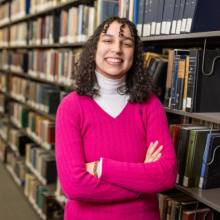
Genesis Batista, Class of 2027
“I wanted to challenge myself to do something outside my comfort zone,” Batista says. “Knowing I was going to spend two weeks in Rome and come back more confident made me feel like I really wanted to do it.”
Rome Connection was conceived in 2022, signaling an expansion of the Office of International Programs’ wide range of study abroad opportunities. It’s an offering that provides a group of about 70 first-year students with two and a half weeks of on-the-ground learning in the Eternal City. The goal of the program is to enrich the academic curriculum and broaden individual perspectives by immersing students in a foreign culture steeped in history and spirituality. The program’s name reflects its focus on helping students connect with their identity, community and the city of Rome that shaped the University’s founder, Bishop James Roosevelt Bayley.
Over the past four years, a number of donors have contributed to Rome Connection scholarships, which cover a portion of the program cost for students facing financial constraints.
In preparation for the life-changing journey, participants take a special course studying everything from ancient texts to the works of 20th Century philosophers to Rome itself. Then, at the end of their spring semester, they travel 4,300 miles and reflect on those teachings while taking in wonders such as the Vatican, the Catacombs and the Appia Antica. The program also stands out by immersing students in lesser-known Roman neighborhoods, where they engage with local culture, service and art beyond the historic center.
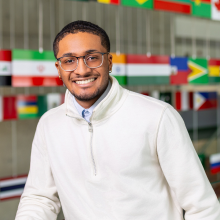
Zahir Mooring, Class of 2027
Another enthusiastic Rome Connection alum is Zahir Mooring, who while in middle school in Franklin Park, New Jersey, participated in a study abroad trip to Ecuador. “It was the first time having an experience that was completely foreign to me,” Mooring says. “It exposed me to a sense of curiosity about what other countries are like.”
Mooring’s curiosity was piqued once more when he learned about Rome Connection, which he saw as a chance to travel abroad for the first time since his formative Ecuador experience. Two things about the program stood out: the itinerary and the journey’s basis in faith. “I saw it as an opportunity to explore my faith through a country built upon faith itself,” he says.
At Seton Hall, students are encouraged to pursue transformational study abroad opportunities, and they should be able to pursue those opportunities regardless of financial circumstance. That’s why the Office of International Programs fundraises to provide Rome Connection scholarships to those who need them. Over the past four years, a number of donors have contributed to these scholarships, which cover a portion of the program’s cost. Without this generosity, Rome Connection would not have been possible for many of the students.

It exposed me to a sense of curiosity about what other countries are like." - Mooring
Batista and Mooring are currently in their junior year at Seton Hall and scholarship recipients from the 2024 cohort. Their stories illustrate how the study abroad scholarships help students build confidence, strengthen leadership skills and shape their views of the world.
Batista relished the faculty-guided parts of the trip, such as visiting museums, touring different neighborhoods and attending the papal audience with Pope Francis. (Hers would be the last cohort to do so before his death the following year.)
But it was the days when students were permitted to explore the city on their own that truly instilled a sense of personal development. Solo excursions as simple as hopping on the metro or watching a movie in a park at night felt like revelations.
“I experienced that personal growth, that feeling that there are new things I can do, that there’s a new way of looking at the world,” says Batista. “It helped me understand that just because things work a certain way where I grew up, that’s not necessarily how they work in other parts of the world.” One day, a piece of street art caught Batista’s eye. “Souls don’t meet by accident,” it said, in English. “It felt like a personal message to me and everyone else on the trip,” Batista recalls.
Mooring savored his side trip to Lago di Bracciano, a volcanic lake with otherworldly black sands and ferries to three towns that dot the shore. “These are once-in-a-lifetime experiences, especially for someone who comes from a background where I don’t have a lot of money to spend on international travel,” says Mooring. “You become addicted to exploring new things.”
Rome Connection is deliberately designed to keep students on track academically. The result is a program that enhances, not interrupts, students’ progress during their freshmen year.
Overall, Rome Connection has succeeded in pushing Batista outside her comfort zone. She recently completed another study abroad experience, a spring break trip to Mexico that involved visiting hospitals and medical schools to learn about how the country’s healthcare system connects with Catholicism.
“These two trips are giving me an understanding of faith from a more analytical perspective. How it influences the ways in which people experience the world,” she says.
I wanted to challenge myself to do something outside my comfort zone." - Batista
Mooring applies what he learned from Rome Connection to his work as a peer advisor in the Office of International Programs, where he now guides fellow students in their own study abroad journeys. One of the most important ideas he conveys to them about the experience of learning in a foreign country? “It really broadens your perspective of people you might not have a lot in common with culturally.”
